A walk-through of what actually happens from the moment you call Heartland — first phone assessment, onsite response, containment, equipment setup, and Xactimate documentation.
The first call to a restoration company is made under pressure. Water is running, or smoke is still thick, or sewage is backing up into a basement. You are not at your analytical best and you should not have to be. This article walks through exactly what happens when you call Heartland — what to expect on the phone, how fast someone arrives, what the first onsite hour looks like, what equipment shows up, and how the paperwork gets built in parallel. So the next time something goes wrong, the call is not the hard part.
The Initial Phone Call
When you call 805-219-6732, the phone goes to Heartland. Not a national dispatch center. Not a call center in another state. During business hours — Monday through Friday, 7:30am to 5:00pm — the call goes directly to a team member. After hours, the emergency line forwards to whoever is on call that night, with a fee applied for after-hours response.
The first call has a specific purpose: establish whether this is an active emergency and gather the information needed to respond. A trained team member will ask:
- What is happening right now? Standing water, active leak, fire cleared by fire department, smoke intrusion, sewage backup, or something else.
- Is everyone safe? People and pets out of the affected area if needed.
- Is the source stopped? If water is still running, we walk you through the shutoff immediately.
- Where is the property? City, address, and whether the structure is residential or commercial.
- When did this start? Now, within the last hour, overnight, yesterday.
- What else is affected? Multiple rooms, electrical panels, HVAC system, stored contents.
- Is your insurance carrier aware yet? Usually no — and that is fine, we often recommend scoping the damage before opening the claim.
This takes five to ten minutes. By the end of the call you have clear next steps: we are on our way, or we are scheduling a response for first thing in the morning, or we are walking you through interim steps to stabilize the situation until we arrive.
How Fast Someone Arrives
During business hours in Ventura County, response is within one hour for active emergencies. For properties in Ventura, Oxnard, Camarillo, and immediately adjacent communities, that is typically faster. For the furthest corners of the service area — Goleta, Agoura Hills, Westlake Village — drive time is the constraint, but response still happens same-day for any real emergency.
Our 24/7 emergency availability covers nights, weekends, and holidays with an after-hours response fee. For active emergencies happening overnight — a burst pipe at 2am, a fire the department just cleared — we respond. The trade-off is the after-hours fee; the alternative is hours of additional damage accumulating while you wait for business hours.
For non-emergency situations — damage that has already been stabilized, an assessment of a prior loss, scheduled work — response is scheduled for the next business day at a time that works for both of us.
Step 1 — Onsite Safety Assessment
The first thing a technician does when they arrive is assess safety. Not start demo. Not set up equipment. Safety.
For a water loss, the technician checks whether electricity is safe to leave on in the affected area. If water has reached outlets, panels, appliances, or live wiring, breakers come off before anything else. They check for slip hazards, sagging ceilings, and structural concerns. For Category 3 water — sewage or flood water — PPE goes on and containment gets planned before entry extends beyond the initial assessment area.
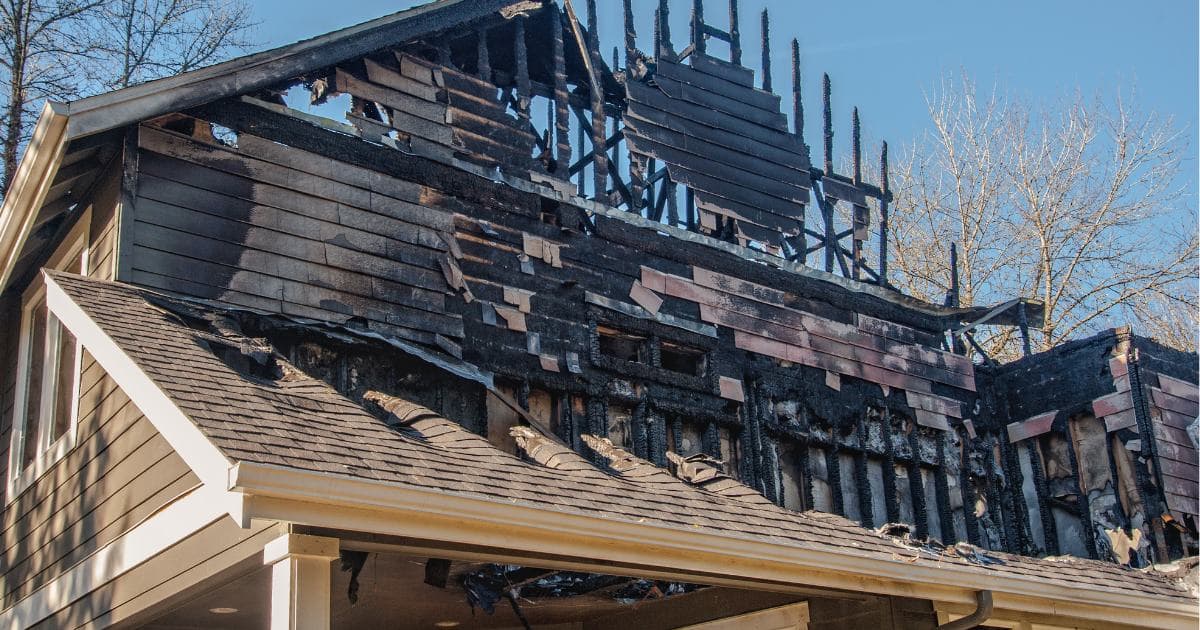
For a fire loss, the structure is walked only after fire officials have cleared it for entry. The technician checks for compromised framing, exposed electrical, and any hot spots the suppression effort may have missed. Board-up and tarping to stabilize the envelope are the first priorities.
For smoke-only scopes — structures that did not burn but have smoke intrusion — safety assessment is lighter, but HVAC is usually turned off immediately to stop recirculation of contaminants.
Step 2 — Source Control and Initial Documentation
If the water source is not yet stopped, it gets stopped. Pipes are clamped, supply lines shut off, standing water noted. If the cause is still unclear, the technician works backward from the damage pattern to identify it.
Simultaneously, documentation begins. Wide-angle photos of every affected room. Close-ups of the damage. Moisture readings on walls, floors, and ceilings with a calibrated meter. Thermal imaging where hidden moisture is suspected. Notes on affected materials — drywall, insulation, flooring, cabinetry, framing — with square footages.
This documentation becomes the foundation of the insurance claim. It is why the first hour onsite matters so much. What gets captured in that hour becomes the Xactimate scope the adjuster reviews.
Step 3 — Containment Setup
Before any demo or cleaning starts, containment goes up. Plastic sheeting, zipper doors, and negative air machines are set up to isolate the affected area from clean areas of the home or business. This prevents moisture, dust, spores, and particulates from migrating into unaffected rooms during the work.
For water losses, containment is typically localized — the affected room or wing. For fire and smoke work, containment is more elaborate — HEPA air scrubbers running continuously, sometimes multi-room isolation, and careful control of airflow direction.
Step 4 — Equipment Deployment
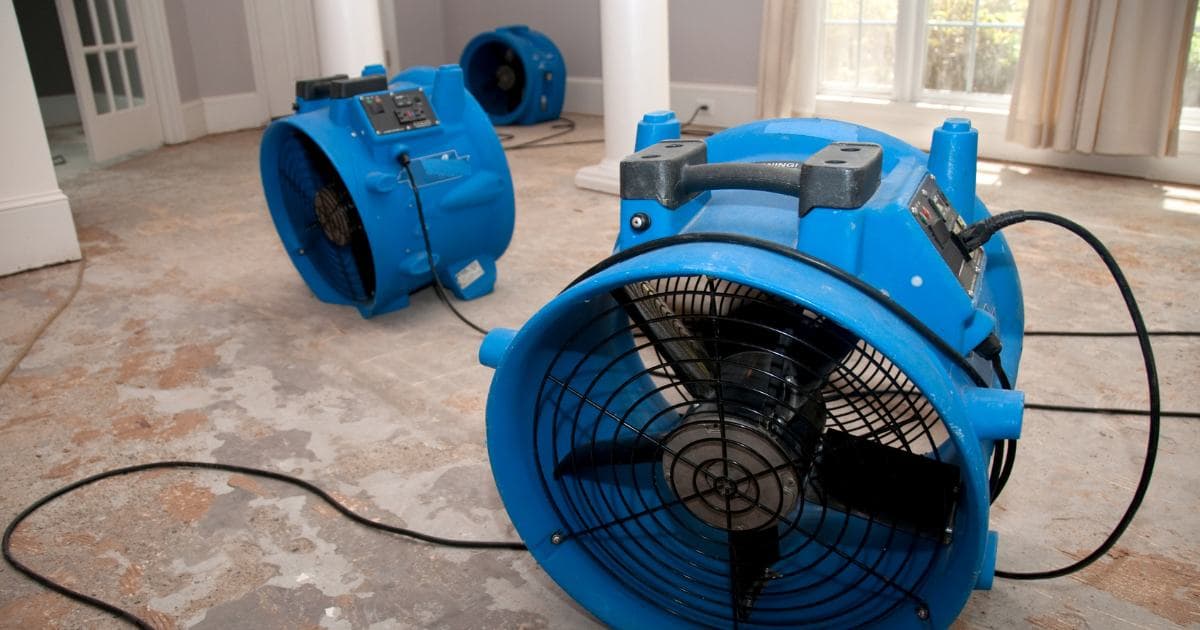
What you see next is equipment. A lot of equipment. For a typical water loss in a 2,000-square-foot home, that includes:
- Commercial LGR dehumidifiers — typically two to four units, each pulling 120 to 240 pints per day.
- Air movers — 10 to 20 units placed at calculated angles to wet surfaces, moving 2,500 to 3,500 cubic feet per minute each.
- HEPA air scrubbers — one to three units running continuously to filter particulates from the air.
- Moisture meters and thermal imaging cameras — used twice a day to track dry-down.
- Containment materials — plastic sheeting, zipper doors, tape.
For fire and smoke work, add hydroxyl generators (typically running 24/7 for several days), HEPA air scrubbers running continuously, and sometimes ozone generators for unoccupied spaces. The equipment is a meaningful part of the scope cost because it runs for days — daily equipment rental and operation is a legitimate line item in the Xactimate scope.
Step 5 — Day-by-Day Monitoring
Restoration is not "set it and forget it." A technician returns daily (sometimes twice daily) to:
- Take moisture readings and log them against the previous day's readings.
- Adjust air mover placement as materials dry unevenly.
- Add or remove dehumidifiers based on the humidity curve.
- Photograph progress at each visit.
- Update the Xactimate scope as findings evolve — secondary damage uncovered, materials confirmed unsalvageable, scope adjustments logged for the adjuster.
The documentation produced during this monitoring phase is what the insurance claim ultimately pays out on. Daily moisture logs demonstrate the drying effort. Progress photos show the work completed. Scope updates reflect real findings.
Step 6 — Mitigation Completion and Transition to Rebuild
When moisture readings confirm the space is dry — typically 3 to 5 days for a standard water loss, longer for severe or complicated ones — mitigation ends. Containment comes down. Equipment is removed. A final walkthrough documents the dry state.
From there, the project either hands off back to the homeowner (if the scope was purely mitigation) or transitions directly into rebuild. Drywall, insulation, flooring, cabinetry, fixtures, paint. Heartland's general construction department handles the rebuild under the same contract, so there is no handoff to an unfamiliar contractor. The same team that scoped the loss runs the rebuild — which means the scope matches and the work finishes on one timeline.
Owner Involvement
One detail worth naming: a team member answers the phone on most calls during business hours, and a manager is typically onsite for assessments of any significant loss in Ventura County. This is not a marketing line. It is how the business runs. The ownership is involved in the work, knows the customer, and is accountable for the outcome. National franchise restoration companies are structured differently. They can be excellent, but the owner is not on your job. At Heartland, the owner is.
For commercial clients in Oxnard and across the county, this matters specifically because commercial work often has occupancy constraints, phasing requirements, and coordination complexity that deserves owner-level attention. The owner being accessible during a commercial job is not a luxury.
How Xactimate Documentation Is Built From Day One
One principle guides how Heartland documents jobs: Xactimate scope-building starts on day one, not at the end. Every photo, every moisture reading, every material note goes into the scope as it is gathered. By the time the mitigation is complete, the Xactimate scope is essentially done — which means the claim is ready to move forward the moment the adjuster wants it.
This is in contrast to the "we'll build the scope at the end" approach some contractors use, which leaves homeowners waiting weeks after mitigation for the paperwork to catch up. Scope is built as the work happens. The homeowner sees the documentation. The adjuster sees the documentation. Nothing gets lost in transcription.
Companion scope for fire damage restoration, odor abatement, or any other service that runs in parallel gets integrated into the same master Xactimate document. One scope, one story, one invoice to the insurer.
Business Hours and 24/7 Emergency Availability
Standard business hours are Monday through Friday, 7:30am to 5:00pm. Phones are answered by Heartland directly during those hours. Non-emergency inquiries, scheduled assessments, and free estimates happen during business hours.
For active emergencies — water still running, fire just cleared by the department, sewage actively backing up — the emergency line operates 24/7 with an after-hours fee for nights, weekends, and holidays. The fee covers the cost of responding outside business hours. It is not a price per emergency, it is a response fee added to the scope.
Dealing With This Now?
Heartland offers free estimates across Ventura County. Call 805-219-6732 or submit a request online.
Frequently Asked Questions
What happens when I call a restoration company?
A trained team member gathers information about the damage, safety status, and location, and establishes next steps — immediate response, same-day scheduled response, or interim stabilization steps while we arrive. The call takes five to ten minutes. At Heartland, the call goes to the owner or a team member, not a national dispatch center.
How fast will someone arrive after I call?
Within one hour during business hours for active emergencies in the core Ventura County service area. Outlying communities like Goleta, Agoura Hills, and Westlake Village are drive-time bound but still same-day for emergencies. After-hours emergency calls are responded to based on the nature of the emergency with an after-hours fee.
Do I need to be home during restoration work?
Typically yes for the initial assessment and scope-building — it helps to walk the property with the technician and confirm access, contents handling, and any constraints. During the drying phase, daily equipment checks can often be done with key access if you prefer not to be home. For fire and smoke work, or for significant rebuild scope, homeowners often relocate via ALE coverage and the contractor works with key access.
How disruptive is the restoration process?
It depends on scope. For a contained water loss in one room, daily equipment noise and reduced use of that area are the main disruptions. For a whole-home fire restoration, the home is typically unoccupied during active work. We coordinate with the homeowner's schedule where possible and respect the fact that this is your home — not a jobsite we control.
Will restoration workers explain what they are doing?
Yes. Every technician is expected to walk you through what is being done, why, and what to expect next. If something is unclear, ask. The work is technical but not secret. Moisture readings, equipment placement, scope decisions — all of it should be transparent to the homeowner.